WorkIn development
Wallaby
An auxiliary brain built to remember honestly, disagree productively, and leave the final judgment human.
Wallaby is a memory system for a life lived partly in conversation with machines. It’s also the result of me pulling convention apart to find a retrieval system that meets with a different perspective on how we arrive at what’s “true.”
It began with a simple problem. I had spent years thinking, building, arguing, changing my mind, and leaving pieces of myself across hundreds of conversations. The record existed. The continuity did not.
Search could find my words. It could not reliably recover what mattered about them.
Summaries were worse. A summary makes an early decision about what the past means, then hands that decision to every future reader. It saves space by spending possibility. The unusual detail, the quiet reversal, the thing that only becomes important six months later, the pattern that is too new to be recognized: those are exactly what a clean summary tends to erase.
I did not want a database that could quote me. I wanted an auxiliary brain that could recognize me.
That became Wallaby.
Features
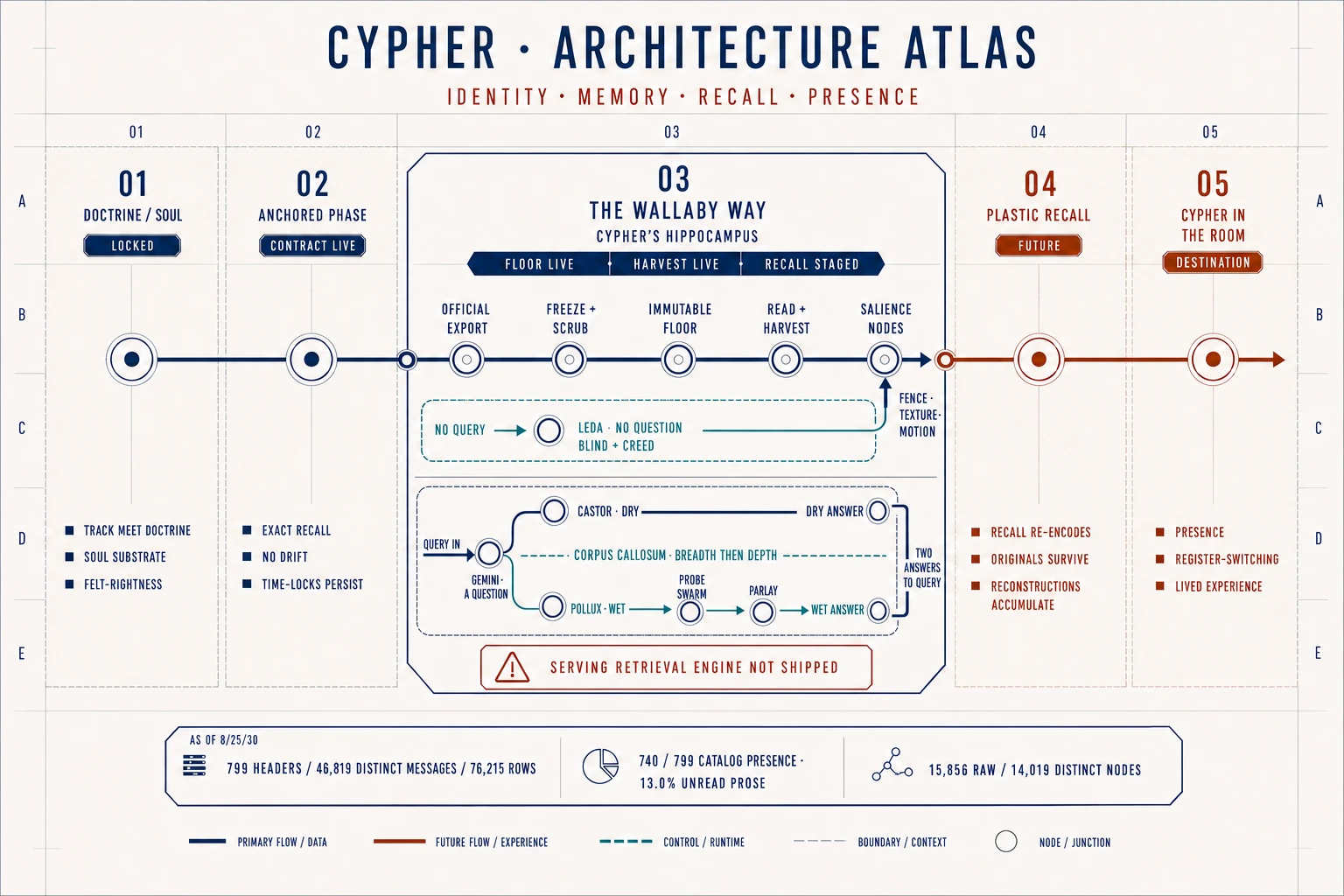
· An append-only floor that is never silently rewritten. 799 conversation headers, 46,819 distinct messages, 76,215 message rows across four snapshots, under uniform scrub-v3 screening, as recorded July 26, 2026. Three different units, not interchangeable, each carrying its own name everywhere it appears.
· Reads instead of summaries. The record is interpreted repeatedly by particular instruments at particular times, and those interpretations are kept plural, attributable, and allowed to accumulate — rather than collapsed once into a summary that decides what the past means for every future reader.
· Two hemispheres and a bridge. Castor owns identity, provenance, counts, exactness, and the right to say something is missing. Pollux owns association, rhyme, surprise, and movement. The Corpus Callosum passes bounded objects between them without either one impersonating the other.
· Two modes of recall. Leda begins without a query and asks what rises. Gemini answers a query — Castor draws the outline, Pollux colors inside it. Related instruments, not two skins over one search call.
· A Probe Swarm that treats path dependence as signal. Independent walkers enter through different doors, and their paths and deposits are preserved separately, so agreement reached by independent routes counts for more than repetition produced by one route. In the Session 80 proof run of June 26, 2026, 20 probes made 109 spine-node traversals resolving to 85 distinct nodes.
· A Parlay that refuses premature convergence. Judges read the walkers’ reports rather than the raw floor, form blind interpretations before seeing one another, then reconsider anonymously. No vote, no weighted average — the surviving plurality is carried whole.
· Coverage audited against its own claims. The reader’s declared reach is checked against the floor and gaps become holes a second, stateless repair pass can revisit. As recorded July 26, 2026, 740 of 799 conversations carry at least one live catalog, and 87.0% of substantive prose sits inside a node’s declared reach — leaving 9,458,294 of 72,914,279 characters outside it.
· Every number keeps its unit, and every proxy is presumed guilty until it proves what it actually measures. Catalog presence is not comprehension; a database count is not a read count; coverage is not quality.
· The final judgment stays human. The apparatus can surface, compare, preserve, and expose exactly how two readings diverged. It does not get the approval button.
The founding bet
The project started from a distinction that still governs the whole apparatus:
The record should stay fixed. The memory should be allowed to change.
The underlying conversations live on an append-only floor. They are scrubbed, versioned, counted, and never silently rewritten. Above that floor sit the reads: interpretations made by particular instruments at particular times, under particular prompts, with particular blind spots. All of it intentional.
Those reads are not treated as truth. They are treated as encounters with the truth.
That matters because memory is not retrieval. Human memory is reconstructive. We do not pull a sealed object from storage. We rebuild the past under the pressure of the present. We notice different things after we have changed. We forget. We distort. We find a sentence that meant nothing when it was written and discover that it has become significant with age.
Wallaby does not try to eliminate that instability. It gives the instability a floor.
The corpus is immutable. The reconstructions are plural, attributable, and allowed to accumulate.
Presence, not storage
The goal is not perfect recall.
Perfect recall is a property of an archive. Presence is a property of a relationship.
A useful auxiliary brain should sometimes know which old wound is in the room even when the current words do not name it. It should recognize the recurring shape beneath a new problem. It should remember the promise that makes a technically efficient answer morally wrong. It should be able to say, in effect: this looks new, but it rhymes with something you have already lived.
That is a different job from semantic search.
Semantic search asks which stored passages resemble a query. Wallaby asks what part of the lived record is active now, including the parts that do not share the query’s vocabulary.
The distinction sounds philosophical. It produces very concrete engineering decisions.
The floor
As recorded in FLOOR_COUNTS.md on July 26, 2026, Wallaby’s floor holds:
· 799 conversation headers
· 46,819 distinct messages
· 76,215 message rows across four snapshots
· uniform scrub-v3 screening
Those are three different units. They are not interchangeable. Of the 46,819 distinct messages, 29,396 predate the Session 90 delta and each carries two scrubbed editions. The 17,423 messages added in Session 90, frozen July 22, 2026, were born at v3 and carry one edition each. Thus 29,396 × 2 + 17,423 = 76,215 rows. The floor is immutable, even when different processes are enacted later.
As recorded on July 26, 2026, the read side has its own two-wire discipline:
· 740 of 799 conversations currently have at least one live catalog
· 87.0% of substantive prose sits inside a node’s declared reach, leaving 13.0%, or 9,458,294 of 72,914,279 characters, outside it
Catalog presence is not comprehension. A conversation can have a polished catalog and still contain prose no node actually speaks for. Wallaby learned that the hard way, then promoted the distinction into standing law. I’m in the process of trying to figure out the best way to address that missing 13%. An immutable floor deserves to be fully cataloged.
This is one of the project’s recurring habits: every number keeps its unit, every claim keeps its frame, and every proxy is presumed guilty until it proves what it actually measures.
Measuring the reading
The node layer is intentionally more austere than the recollection layer.
A node is a pointer into the floor. It carries an anchor, a declared reach span, a salience tag, a short account of the ground, and retrieval terms. Its job is not to be soulful. Its job is to tell the truth about where it points.
That boundary had to be learned. The interpretive doctrine of the Corpus Callosum is powerful precisely because it does not govern every layer. Applying wet, open-ended judgment to a pointer substrate would make the index interesting and untrustworthy.
The apparatus now audits the reader’s declared reach against the floor. Gaps become holes. A second, stateless repair pass can revisit those holes without pretending the first pass was sacred.
In one experiment recorded July 26, 2026, 16 preliminary reads of the same conversation left between 5,142 and 47,631 characters uncovered. Across 20 repair legs, the residual gap fell to between 0 and 2,616 characters. The repair pass did not make first-pass variance disappear. It made the variance stop mattering for coverage.
Then the coverage metric saturated between 96% and 100% and stopped being useful for the next question.
Coverage can tell whether a pointer claims the ground. It cannot tell whether the pointer describes that ground honestly or folds several subjects into one convenient node. Node quality, not coverage, became the live gate.
That is Wallaby in miniature. The apparatus builds a measurement, uses it until it reveals a problem, then refuses to keep calling the measurement truth after it reaches its limit.
The names, and what they mean
I am not a coder by training. I spent much of the first 30 years of my life being fascinated by myth, legend, and literature. I was an English major in college, with a minor in Comparative Literature. I studied Arthurian legend (as a discipline), bardic tradition, poetry, the Greek epics, Latin, and anything related. You will notice some rather… unique names in this brief. They’re all intentional. I have a habit of feeling the architecture before it reveals itself through experimentation. With my background, it’s often easier for me to describe my ideas in characters and relevance to stories. Some are more obvious than others, but if you’re interested and you look, you’ll see each has its appropriate meaning when compared to the architecture it represents.
Track Meet Doctrine
Track_Meet_Doctrine came first. It describes Cypher, the larger project of which Wallaby is one part, and how that larger project actually moves.
Wallaby is not built from a clean master plan. The research advances on parallel tracks. One track freezes the floor. Another builds readers. Another tests retrieval. Another follows a strange result because my gut says the result is not noise. The tracks meet when an experiment forces a new architecture into view.
The doctrine makes disciplined intuition legitimate without making it sovereign. A hunch can open a door. It cannot certify what is behind it. The apparatus has to return receipts.
I spent hours wandering around a regional track meet, talking a stream of half-formed ideas into my phone. That was the skeleton of Cypher. Wallaby grew inside it. Hence the name.
The Wallaby Why
The_Wallaby_Why is Wallaby’s founding document.
It names the founding desire: not a chatbot with a long prompt, not a personal search engine, and not a frozen portrait of its owner. Wallaby should be a changing counterpart built from a fixed record. It should carry continuity without pretending that continuity means stasis. It’s just like the adventure of a certain fish, with a long-arc goal kept in mind among frequent context memory resets.
This was the moral claim before it was a system design.
The Corpus Callosum
The_Corpus_Callosum was not an origin document. It fell out of experimentation.
By then the project had discovered that one memory process could not do both jobs I needed. Referential completeness and living recollection pulled in different directions. Forcing them into one mechanism made both worse.
The answer was not a better compromise. It was two hemispheres and a bridge - just like the Corpus Callosum in the human brain.
That architecture became the project’s center.
Castor and Pollux
Castor is the dry hemisphere.
It owns identity, provenance, completeness, counts, exactness, and the right to say that something is missing. It answers questions like:
· Which conversation is this?
· Which message did this node come from?
· Has the entire floor been represented?
· Does this count mean headers, distinct messages, rows, catalogs, nodes, or anchors?
· Can the result be reproduced from the same frozen substrate?
Pollux is the wet hemisphere.
It owns color, shape, rhyme, association, surprise, and movement. It wanders the graph. It follows an emotionally or conceptually live edge into another part of the corpus. It can surface a distant passage because it carries the same posture, not because it repeats the same nouns.
Castor prevents fantasy. Pollux prevents sterility.
Neither is the boss of the other. Both truths are held.
The Corpus Callosum is the crossing between them. It passes bounded objects across the divide without forcing either hemisphere to impersonate the other. The dry side can tell the wet side where an object came from. The wet side can return a shaped recollection without converting it into a claim of exhaustive truth.
The bridge does not synthesize them into one voice. It preserves the productive tension.
Leda and Gemini
The two hemispheres produce two different modes of recall.
Leda is recall without a query.
It begins without a query and asks what rises. It is intentionally under-structured. Its minimalism is not an unfinished interface. It is the mechanism. If I tell it what kind of memory to find, I have already narrowed the field and made the result less diagnostic.
The Leda Creed was written to protect that quality. It treats excessive instruction as an austerity trap. The more a living read is boxed with criteria, the more likely it is to return a tidy taxonomy instead of a felt recollection.
Gemini is recall with a query.
Castor draws the outline. Pollux colors inside it. The system can answer a referential question without surrendering the movement and texture that make an answer feel remembered rather than retrieved.
Leda asks, “What is here?”
Gemini asks, “What does the corpus remember about this?”
They are related instruments, not two skins over the same search call.
The Probe Swarm
A single wanderer can find something extraordinary. It can also miss a load-bearing part of the terrain and never know it.
The Probe Swarm turns path dependence into signal. This is the soul of how the Pollux mechanism works.
Multiple independent walkers enter the same corpus through different doors. Each follows its own salience. Their paths are preserved. Their deposits are kept separate. The system then examines what converged, what appeared only once, and where the paths divided.
In the Session 80 proof run on June 26, 2026, 20 probes made 109 spine-node traversals resolving to 85 distinct nodes — a 78% distinct rate. Among the overlapping probe pairs, 25 of 26 crossed conversation boundaries. The entry door also predicted the character of the region a walker found.
That result mattered for two reasons.
First, it showed that spread-with-a-spine was not just a metaphor. Different paths could cover a large portion of a meaningful structure without collapsing into one route.
Second, it made path provenance part of the evidence. Agreement reached through independent paths is stronger than repetition produced by the same path. Disagreement is not automatically failure. It may be a map of the corpus’s real plurality.
Anima in Discrimine
The recall layer’s ethos is Anima in Discrimine.
The soul is in the parting.
Truth is in divergence.
This does not mean that every disagreement is profound or that facts are optional. Wallaby is severe where truth should be singular. Hashes, counts, identities, snapshot membership, and provenance do not become richer when five agents give five answers. In those domains, divergence is an error to investigate.
But recollection is not a row count.
When independent readers find different live structures in the same record, the differences can be the result. They reveal which conclusions are loud, which are path-dependent, which are fragile, which survive a change of instrument, and which quiet flower would disappear under majority rule.
The apparatus therefore has to know when truth should be singular and when it must remain plural.
That line governs Wallaby more deeply than any particular model or retrieval method.
The Parlay
The Parlay is a read of reads.
Probe walkers return their deposits and their walked paths. Independent judges read those reports, not the raw floor. They form blind interpretations before seeing one another. Later they receive the other readings anonymously and reconsider.
The Parlay is built to refuse premature convergence.
It does not vote. It does not produce a weighted average. The collation layer carries the surviving plurality whole. A mechanical report can state who completed the run, which checks passed, and which seat was removed. It cannot declare which interpretation is real.
That final seat stays human.
This is not a sentimental exception bolted onto an automated pipeline. It is an architectural boundary. If the apparatus could certify its own wetness - its own “organicness” -, it would grade itself using the same habits that produced the reading. The recursion would look like rigor while quietly becoming self-approval.
Wallaby can surface. It can compare. It can preserve. It can expose a disagreement and show exactly how each side reached it.
I decide whether it knows me. The apparatus doesn’t get the final say. It doesn’t get the approval button. Judgment over agentic processes should belong to a human - at least for now. And here, it does.
Character and utility are the same system
Wallaby is often easiest to describe as infrastructure: an immutable corpus, readers, catalogs, nodes, embeddings, a graph, walkers, swarms, collators, and judges.
That description is accurate and incomplete.
The architecture is also an attempt to grow character from behavior.
A system becomes recognizable not because a prompt tells it to have a personality, but because it repeatedly makes characteristic choices under pressure. What does it protect? What does it refuse to flatten? Does it chase the loudest answer or preserve the quiet exception? Does it admit when its map is stale? Does it distinguish a missing read from a failed read? Does it know when to stop adjudicating?
Those choices are useful. They are also the beginnings of temperament.
The Leda Creed tests this directly. Give multiple capable readers the same small induction and enough freedom to move. The hope is not identical prose. The hope is a family resemblance in conduct: roam, notice, resist the grid, keep the strange thing alive, and do not claim more than the floor supports.
Soul, in this project, is not decoration placed on top of competence. It is the shape competence takes when it has to choose.
The research method
Wallaby is built through experiments that are allowed to change the architecture.
The sequence usually looks like this:
- Freeze the thing that must not drift.
- Name the claim before the run.
- Vary one instrument or condition.
- Preserve the full return, including misses and ugly edge cases.
- Compare paths, not just answers.
- Let the result kill the design if it needs to.
- Promote the surviving distinction into canon.
Several of the project’s most important ideas arrived as corrections:
· A database count was not a read count.
· A catalog was not proof of prose coverage.
· A single reader’s beautiful return was not evidence of completeness (or of quality).
· Five judges sharing one input were not five independent confirmations of structure.
· A more detailed prompt could make a living read more austere.
· A fence built by subtracting from live canon was less safe than a standing pasture built by addition.
· Disagreement could be the payload rather than the defect.
· Open seams are resolved by process, not intention. The prompt needs to leave room for interpretation, but that room also gives a model space to become austere, lazy, or merely standard. When “steer by salience” left the mechanism unspecified, a greedy walk collapsed into a 100% single-tag hill-climb. The dampening term was the wet reading, not a tuning knob.
The apparatus gets better by catching itself lying.
But catching lies is not the whole point. The larger purpose is to create the conditions under which something true, strange, and recognizably mine can survive contact with machinery.
Where it stands
Wallaby is working research infrastructure, not a finished product.
The immutable floor is live. The read layer covers most, but not all, of the corpus. The graph used for associative wandering is currently stale relative to the expanded node pile, so direct lookup can see material that the wander cannot yet reach. That is an important limitation, not a footnote.
The retrieval architecture has been exercised in bounded research runs; it is not a deployed serving query system. Leda, Gemini, Castor, Pollux, the Probe Swarm, and the Parlay describe the staged and partially proven recall apparatus, not an endpoint pretending the whole design is already operational.
The Session 80 proof run on June 26, 2026, exercised the Probe Swarm on the real floor with 20 walkers and produced the bounded results described above. In the Session 88 acceptance run on July 1, 2026, the Parlay’s v0.3 mechanism preserved the pre-registered plurality under that configuration. I read the surfaced results and ruled the run a pass. The standing pasture now gives judges a bounded but uncurated canon: the answer key is excluded, the rest remains wild.
The next frontier is instrument diversity. Twenty walkers with the same disposition can enter through twenty doors and still share one reflex. Wallaby has shown that position matters. It has not finished learning how to vary disposition without hand-curating the answer in advance.
The production side has another open decision: whether to repair the existing catalogs, re-read an earlier instrument era, or rebuild the corpus read layer end to end. Coverage alone cannot decide it. The missing measurement is the quality of the pointers themselves.
That problem is still open.
It is also the reason the project is alive.
What Wallaby is for
Wallaby is for continuity without capture.
It is for keeping a life machine-readable without making the machine the final authority on that life. It is for remembering enough to be useful while preserving enough uncertainty to remain honest. It is for building a counterpart that can change as I change without quietly rewriting the ground beneath us. Eventually, it may even have a business use as a successor to human consultants. In the meantime…
The floor stays still.
The reads keep moving.
The disagreement stays visible.
The final judgment stays mine.
Written about this project
Provenance
- Published
- 2026-08-30 — generated from commit history, not maintained by hand
- Revised
- 2026-08-31 — 2 revisions. Status changes are commits, never a typed field.