Track_Meet_Doctrine came first.
It was the full concept, and the project it described was Cypher.
The_Wallaby_Why came later. Wallaby began at the origination of Cypher’s memory and recall function, and the Why said what that piece was for.
That order matters, and it is easy to get backwards. Wallaby is a subset of Cypher, not its parent, and it did not generate the doctrine it runs on. It arrived into a project that already had one.
What Wallaby did was put that doctrine under load. Wallaby was not born with Castor and Pollux, a Probe Swarm, a Parlay, or a polished two-hemisphere architecture. It began with a human need and an immutable floor. The rest arrived because experiments kept breaking the available explanations.
Track Meet is the document that made that kind of progress legitimate.
A project with more than one track
The clean version of research is sequential.
State a question. Form a hypothesis. Build a test. Read the result. Move to the next question.
Wallaby rarely behaved that way.
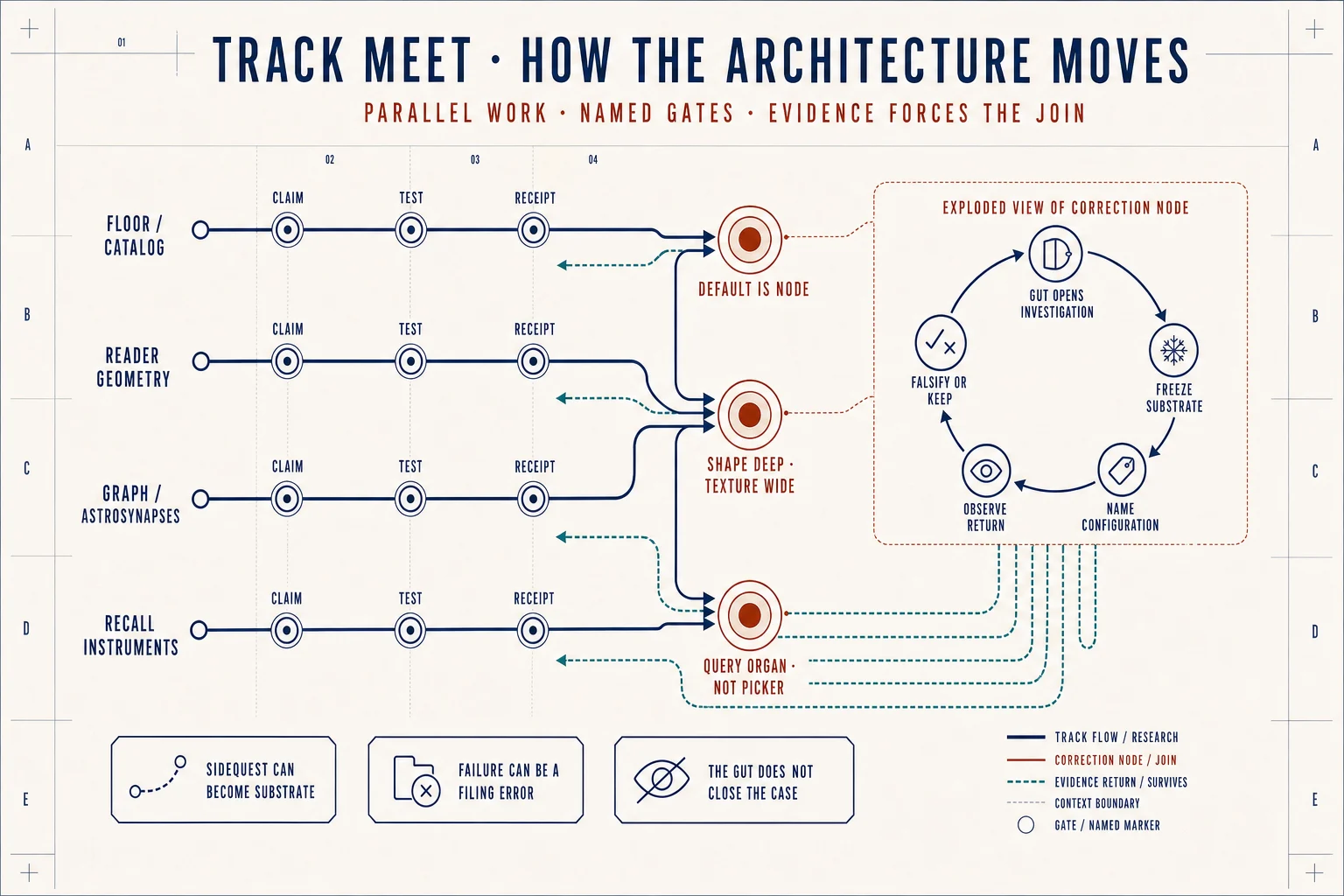
The floor could be frozen while a reader prompt was being tuned. The graph could be built while the catalog’s ontology was still moving. A visualizer dismissed as a sidequest could become substrate for a later retrieval organ. A failed recall result could reveal that the problem was not ranking but attention. A hunch about a strange return could open a new workstream before the current one had closed.
The tracks ran in parallel because the object under study was not known in advance.
This was not an excuse for disorder. Each track still needed its own floor, claim, gate, and receipts. The doctrine simply refused the fiction that the master architecture had to be settled before useful work could begin.
The tracks meet when evidence forces them to.
The role of the gut
Jake’s gut has a formal role in this project.
That sentence is easy to misread. It does not mean intuition wins over evidence. It means intuition is allowed to decide where to look before evidence exists.
A felt wrongness can stop a run whose metrics look clean. A strange result can be kept alive when a tidy explanation would discard it. A side project can continue because something about it seems load-bearing even when the current architecture cannot say why.
The gut opens the investigation.
It does not close it.
Closing requires the apparatus: a frozen substrate, a named configuration, an observable return, and a comparison that could have gone the other way.
This creates a productive division of labor.
The human is allowed to notice before he can explain. The machine is required to help make the explanation falsifiable.
The first large correction
Early Wallaby treated cataloging as filtering.
The reader’s job was to keep the important things and drop the rest. It was an elegant premise. It was also an austere one.
The failure was not a bad threshold. It was the wrong job description.
An auxiliary brain needs reachability before selectivity. Over-inclusion costs a later reader some attention. Omission creates a hole that does not announce itself. The absence leaves no object to audit.
The doctrine inverted:
Default is node. Dropping is the exception.
That decision sounds like a catalog rule. It is actually a statement about error cost. In this system, invisible omission is more expensive than visible excess.
The second large correction
The next seeding run balanced reader loads by message count.
The slices looked even. The readers did not experience them as even.
Messages vary wildly in byte size. Several windows compacted under large slices and returned plausible, clean-looking output with the long tail quietly missing.
That is Wallaby’s most dangerous failure class: the artifact that looks successful because the failure erased the material that would have exposed it.
The correction was deeper than changing a ceiling.
Shape and texture wanted opposite reading geometries. Structural decisions require deep, whole reads because a fence can hide inside a large technical block. Recurrence requires breadth across conversations because the pattern does not exist inside any one conversation.
One reader had been asked to do both.
The system split into two passes over one floor.
The shape pass read deep. The texture pass read wide. Each kept its own reconciliation path. The split did not come from architectural taste. It came from watching a single-pass design fail on the actual distribution of the corpus.
Sidequests can be upstream
AstroSynapses began as a visualizer.
It rendered the corpus as a night sky: nodes as stars, similarity edges as structure. A prior reading could dismiss that as cosmetic. A strict project plan could have killed it as scope drift.
It became load-bearing substrate for the semantic wander.
That does not mean every sidequest is secretly essential. It means the category “sidequest” says where a track sits relative to the current plan, not whether it will matter to the eventual system.
Track Meet preserves that possibility. It lets a secondary track return with an object the main track did not know it needed.
A failure can be a filing error
For several sessions, an instrument called Arm 2 sat inside the un-anchored picker layer and failed a validation it could never pass.
The debate centered on whether embedding-based movement was corrupting the picker.
The eventual answer was simpler and stranger: Arm 2 was not a picker.
It was a query organ.
The picker layer, later Leda, had no query and therefore could not use semantic nearness without collapsing its divergent purpose. The query organ, later Pollux within Gemini, began from a question and could use similarity to find a starting shelf before setting the query down and wandering by salience.
The blocked validation dissolved when the instrument moved to the correct layer.
Nothing about the instrument had to be repaired. The taxonomy had to admit it had put the organ in the wrong body.
This became one of Track Meet’s best lessons:
A gate that cannot be passed may be measuring the wrong object.
The project learned to kill its own metrics
The later measurement era made the doctrine harsher.
Wallaby spent several sessions searching for the reader model and effort setting that would reduce first-pass coverage defects. Repeated reads showed enormous variance. A later repair mechanism collapsed the residual gap across those different first passes.
The project had spent five sessions hunting a variable that the new mechanism made largely irrelevant.
That was not wasted work. It established the noise floor and made the repair result legible. But the correct conclusion was not that one instrument had finally won. It was that the system had found a way to stop depending on a winner.
A weaker research culture would keep publishing the high number.
Wallaby retired the measurement from the question it could no longer answer.
The new gate became node quality. Does the pointer honestly describe its ground? Does it preserve one subject rather than generalizing several into a smoother, less faithful node?
The metric had not failed. It had completed its jurisdiction.
Kill table
what this session falsified, and what killed it
Every row below was believed, acted on, and then killed by a result. None of them were stupid at the time; several were elegant.
| Claim | Verdict | Why |
|---|---|---|
| Cataloging is filtering — keep the important, drop the rest. | Wrong job description | A pilot retained roughly one node from about twenty-one conversations, discarding long build sessions with real decisions inside them. Reachability precedes selectivity. |
| Even message counts produce even reader loads. | Wrong unit | Messages vary wildly in bytes. Windows compacted under large slices and returned clean-looking output with the long tail silently missing. |
| One reader can do shape and texture. | Incompatible geometries | Structure hides inside large technical blocks and needs deep whole reads. Recurrence does not exist inside any one conversation and needs breadth. The needs pull slice size in opposite directions. |
| AstroSynapses is a cosmetic sidequest. | Load-bearing | It became the substrate the semantic wander runs on. |
| Arm 2 is a broken picker. | Filing error | It was a query organ sitting in the no-query layer. Nothing about the instrument needed repair; the taxonomy did. |
| The right reader model and effort setting will reduce the coverage defect. | Neutralized, not solved | A later repair mechanism collapsed the residual gap regardless of which instrument produced the first pass. Five sessions chased a variable that stopped mattering. |
| Coverage measures reading quality. | Jurisdiction ended | It saturated at 96–100% across every arm and lost the ability to discriminate. The gate moved to node quality. |
The last row is the one worth sitting with. The metric was never wrong. It answered its question correctly and then kept being asked a different one.
Track Meet as operating law
The doctrine can be reduced to a few rules:
- Keep the substrate still.
- Let multiple workstreams move.
- Let intuition choose a door, then demand receipts from what comes through it.
- Name the configuration under which a finding held.
- Treat a clean-looking return as evidence, not acquittal.
- Preserve failed artifacts when they can become controls.
- If the experiment breaks the architecture, change the architecture.
- If a metric cannot see the new question, stop asking it to.
This is why Cypher accumulated doctrine instead of one master specification, and why Wallaby did the same inside it.
Neither project knew its final shape at the beginning. Pretending otherwise would have protected the plan from the evidence.
Track Meet protected the evidence from the plan.
What the document made possible
The Corpus Callosum arrived later.
It is tempting, looking backward, to read its two hemispheres into everything that came before. The backstory witnesses make that mistake impossible. The S29 seat knew the floor, the catalog, blindness, and the two-pass seed. It had never heard the names Castor, Pollux, or Corpus Callosum. The S53 seat could describe hybrid retrieval and still placed the Callosum beyond its horizon.
The later architecture was not hidden in the beginning, waiting to be implemented.
The conditions for discovering it were.
An immutable floor. Parallel experiments. Honest failure records. A human allowed to say, “That return is wrong,” before he had a formal account of why. A system willing to preserve the wrong turn long enough to learn from it.
The tracks met.
The architecture fell out.
That is the doctrine.