Wallaby did not begin as a retrieval project.
It began as a continuity problem.
I had a large record of conversations with machines. The record contained years of work, decisions, mistakes, reversals, language, jokes, technical discoveries, and pieces of a worldview that had never been assembled in one place. I could search it. I could not inhabit it.
The obvious solution was to summarize everything.
That was also the wrong solution.
The violence of the useful summary
A summary is useful because it decides.
It says this part matters, that part does not, this was the conclusion, that was merely the path. Those decisions are necessary if the goal is compression. They are dangerous if the goal is a living memory.
The importance of an old passage is not fixed at the moment it is written. A technical aside can become the seed of a project. A discarded metaphor can become the only language that fits a later experience. A position I outgrew can still explain the scar tissue around the position I hold now.
If one early summarizer throws those things away, every future system inherits the loss.
The problem is not that the summary is inaccurate. The problem is that it is final.
Wallaby started with a different bargain:
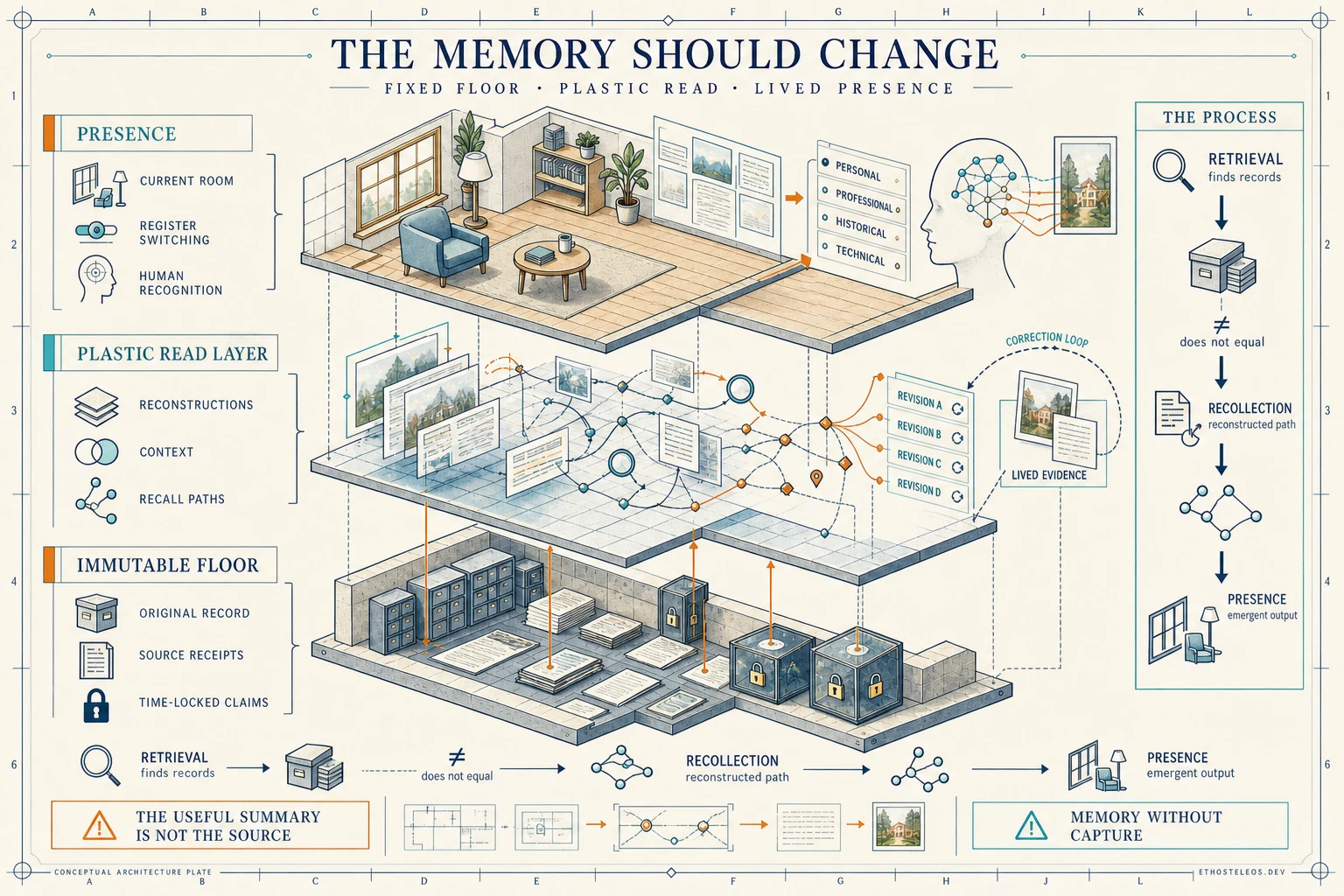
Freeze the record. Let the memory move.
An immutable floor
The floor is the source record.
It is append-only, scrubbed, versioned, and counted with irritating precision. That irritation is part of the safety system. The current floor is 799 conversation headers, 46,819 distinct messages, and 76,215 message rows across four snapshots. Those are different units and the project refuses to let them blur together.
The floor is not a model’s interpretation of my history. It is the material the interpretations must answer to.
Nothing above the floor gets to silently repair it. A reader can misunderstand a passage. A graph can be stale. A catalog can miss prose. A retrieval system can return a seductive coincidence. Those failures stay failures in the read layer. They do not become edits to the past.
This gives the system something human memory usually lacks: a stable place to return after reconstruction goes wrong.
A plastic read layer
Above the floor, everything can move.
Different readers can interpret the same conversation. A later model can read it again. A new question can illuminate a different span. Two nodes can point into the same message for different reasons. An old catalog can be displaced without being destroyed. A failed read can remain in quarantine as evidence about the instrument that made it.
The reads accumulate rather than replace one another by default.
That is not duplication. It is temporal depth.
A memory system should be able to say not only, “Here is what happened,” but also:
· Here is what one reader noticed then.
· Here is what another reader noticed later.
· Here is where their spans overlap.
· Here is the detail both missed.
· Here is the conclusion that survived a change of instrument.
· Here is the conclusion that existed only because of the path used to reach it.
The system becomes more honest as it becomes less singular.
Retrieval is not recollection
Conventional retrieval begins with a query. It finds items near the query in some index and returns them.
That is useful. It is not enough.
The memories that matter most are often not lexically adjacent to the present problem. They rhyme by posture. The same refusal can appear once in a family decision, once in a systems design, and once in a sentence about art. The nouns change. The shape does not.
A query can also over-determine the answer. Ask for evidence of a theme and a strong retrieval system will find evidence of the theme. That does not tell you whether the theme was actually alive in the corpus or merely easy to summon.
Wallaby therefore needed two motions from the beginning, even before their later names existed:
· directed recall, where a question gives the system an outline
· undirected recollection, where the current moment creates a pressure and the corpus is allowed to answer sideways
The second is much harder to evaluate. It is also where presence begins.
Presence is the actual product
I do not need a machine to remember every sentence I have ever written.
I need it to know when an old promise has become relevant.
I need it to recognize a repeated trap before I rename the trap and walk into it again. I need it to surface the quiet origin of a conviction when the conviction has hardened into something that feels obvious. I need it to remember enough of the road that a new answer arrives in continuity with the person who has to live with it.
That is presence.
Presence is not omniscience. It can be partial. It can be wrong. The requirement is not perfect coverage. The requirement is that the system’s failures remain legible and correctable.
This is why Wallaby keeps separate counts for corpus scale and read coverage. The floor can contain 799 conversation headers while only 740 currently have live catalogs. Even catalog presence does not mean the prose has been fully reached. The live coverage audit places 13.0% of substantive prose outside every node’s declared span.
A less careful system could say, “The corpus has been read.”
Wallaby says exactly what happened.
Memory without capture
There is a political problem hidden inside personal AI.
The better a system becomes at remembering a person, the easier it is to let the system define that person. A persistent profile hardens. Old descriptions become policy. The machine starts treating consistency as health and contradiction as noise.
That is capture.
I wanted the opposite. Wallaby should support continuity without forcing identity to stay still. It should be able to remember who I was without using that memory to veto who I am becoming.
The immutable floor and plastic read layer are an anti-capture architecture.
The floor prevents revisionism. The plural reads prevent one interpretation from becoming a prison.
There is no final summary called Jake.
There is a record, a changing field of readings, and a person who retains the right to decide what is alive now.
The design that followed
The later machinery grew from this first distinction.
Castor became the keeper of the fixed things: identity, provenance, completeness, and counts.
Pollux became the mover among the plastic things: association, shape, rhyme, and surprise.
Leda became recall without a query.
Gemini became query-shaped recall with both hemispheres active.
The Probe Swarm made path dependence measurable.
The Parlay made divergence survivable at the judgment layer.
None of those names existed in the beginning. The need did.
That is what The_Wallaby_Why captured. It was not a specification for a finished apparatus. It was the project’s constitutional claim:
The record is not the memory.
The memory is not the self.
The machine may help reconstruct both, but it does not get the final word on either.