I asked five Claudes from different points in Wallaby’s development to describe the project as they knew it then.
The files came from S29, S53, S62, S89, and S104. The S104 seat produced two related references, so the folder holds six documents across five moments.
I expected a better summary.
What I got was more useful: a parallax view.
Each Claude knew a real Wallaby. None knew the whole one. The edges of their ignorance traced the project’s evolution more faithfully than a retrospective account that made every later idea look present from the beginning.
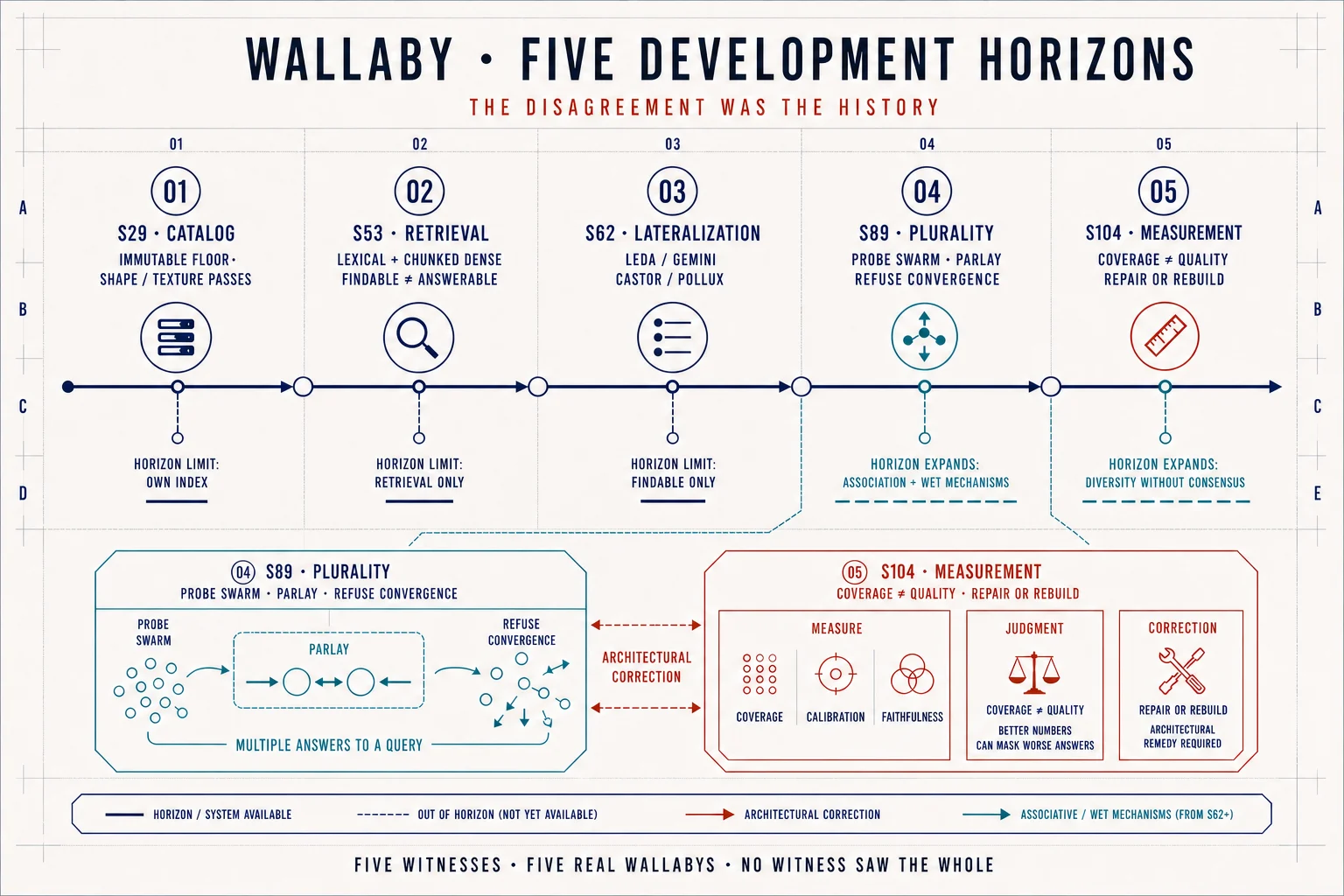
S29: the catalog is not finished
The S29 seat lived the seeding phase.
Its Wallaby was an immutable floor and a pointer catalog still being laid. The central questions were admission, slicing, blindness, compaction, and how to make one pass read for structure while another read for recurrence.
It knew the principle “default is node.” It knew that omission was the expensive invisible error. It knew that message count was a bad proxy for reader load because byte-heavy slices caused silent compaction.
It had never heard of Pollux, Corpus Callosum, the semantic graph, or the Probe Swarm.
That absence matters.
The two-hemisphere architecture was not an implementation detail waiting in a backlog. It did not exist in this witness’s conceptual world.
S29’s honest status was also bracing: the first pass was in flight, the second pass was unbuilt, and downstream reconciliation had not run. The future auxiliary brain was still a corpus being read into an unfinished index.
S53: findable is not answerable
The S53 seat inherited a larger floor and a completed read era.
Its problem was retrieval.
Raw retrieval had been graded poorly. Proper nouns vanished under pure dense search. Long nodes were truncated. A recurring texture question could not be answered by a flat index even when the relevant material was technically findable.
S53 built a hybrid channel: lexical search beside chunked dense embeddings. It could state exactly what one later-misused number meant: 16,533 by 384 was an embedding matrix, not a node count.
That single clarification is a miniature of the project’s epistemic discipline. A number can be accurate and still become false when its unit is stripped.
S53 could see the need for a texture pipeline and a two-stream Confluence. It still had no knowledge of Corpus Callosum or Pollux. Those were beyond its horizon.
Its Wallaby could find. It could not yet hold a theme whole.
S62: the organ was in the wrong body
By S62, Castor, Pollux, Leda, Gemini, and AstroSynapses existed.
The project had discovered the decisive boundary between recall with a query and recall without one.
Leda could not use semantic nearness as its governing motion because it had no query. Doing so would turn a divergent picker into a slow search engine. Pollux could use a query to find a starting shelf, then set the query down and wander by salience.
This distinction solved a multi-session impasse. An instrument called Arm 2 had been treated as a broken picker. It was not broken. It was a query organ filed into the no-query layer.
S62 also carried one of the project’s cleanest warnings: a result can look complete while being an artifact of a broken dial. The first Pollux wander returned a pure pile because one real tag had zero weight, a nonexistent tag occupied another slot, and the anti-saturation guard did not shape ranking. The fixed run produced a mixed return.
Its Wallaby had a semantic sky and early retrieval organs. The answering brain remained incomplete.
S89: divergence becomes machinery
The S89 seat knew the Probe Swarm and lived inside the Parlay.
Here the project’s center of gravity had shifted from retrieval into judgment.
Twenty walkers entered through different doors. Their paths became evidence. Five judges read the walkers’ reports, formed blind interpretations, then received peer reads. The mechanism was designed not to vote but to preserve the plurality the corpus actually returned.
S89 could explain why an earlier Parlay flattened. Judges had been given raw floor material instead of the walkers’ narrated reads. The path evidence disappeared, so the judges converged on loud shared content.
It could also describe a correction happening in its own session. The first canon fence worked by moving answer-key material out of live canon before a run and restoring it afterward. An interrupted run exposed the risk. The architecture inverted: build a standing pasture by copying the allowed set into a separate room, never subtract from live canon.
By S89, Corpus Callosum was no longer an unknown future name. It was constitutional law.
Its Wallaby knew how to refuse convergence.
S104: the project measures the reader
The S104 seat came from the measurement era.
Its Wallaby had stopped asking only whether retrieval worked and started asking whether the pointer layer told the truth about what it claimed to cover.
Repeated first-pass reads varied enormously. A repair pass made most of the coverage gap disappear across instruments. That result neutralized several sessions spent hunting for the perfect reader configuration.
Then the repair metric saturated.
Coverage could show that nodes claimed nearly all the prose. It could not show whether those nodes described the prose honestly. A coarse reader might cover more ground precisely because it generalized several subjects into one smooth node.
The live question became node quality.
S104 also drew a crucial jurisdictional boundary: Corpus Callosum governs interpretive reading, not the node substrate. The pointer layer must be austere-accurate. Wetness belongs above it.
Its Wallaby was mature enough to falsify its own measurements and leave the central rebuild decision open.
The disagreement was the history
The references contradict one another in places.
The floor counts change. A subsystem is absent, then aspirational, then live, then under measurement. One seat treats Cypher as nearly synonymous with the apparatus; another insists it is a separate sibling project. Current canon settles that one: Wallaby is a component of Cypher, not a sibling to it. One knows a number as current; a later seat recognizes it as an earlier snapshot.
This is not noise to edit away.
It is the temporal structure of the project.
Some disagreements are corrected by later canon. The floor ledger settles the counts, and dates them: 799 conversation headers, 46,819 distinct messages, and 76,215 message rows, as of July 22, 2026. It keeps read coverage separate: 740 of 799 conversations with a live catalog, and 13.0% of substantive prose outside declared node reach, as of July 26, 2026.
Other disagreements reveal how the project’s own language changed as its architecture changed.
The right editorial move is not to choose the most confident witness. It is to preserve each witness’s horizon and let the sequence show the emergence.
What only the sequence reveals
Read together, the five moments show several things no single summary can.
The later architecture was not latent code
S29 did not know Corpus Callosum. S53 did not know Pollux. The later names and divisions did not merely label components that had always existed.
The experiments created the need for them.
“Current” is a dangerous word
Every witness can accurately state a current count for its own moment and still mislead a later reader. Wallaby’s own floor ledger exists because precise numbers survive longer than their frames.
The project changes what it thinks the hard problem is
At S29, the hard problem is reading the floor without dropping it.
At S53, it is retrieving texture that flat search cannot reach.
At S62, it is separating query from no-query motion.
At S89, it is preserving plurality through judgment.
At S104, it is measuring whether the pointer layer describes its ground honestly.
Each problem remains real. None remains the whole project.
Honest ignorance is useful infrastructure
The strongest passages in the backstory files are often the refusals.
“That happened after my horizon.”
“I know the number but not the unit.”
“I can describe the setup, not the later inversion.”
“I will not reconstruct a source I cannot read.”
Those are not disclaimers around the knowledge. They are part of the knowledge.
They prevent a later fluent writer from inventing continuity the project did not have.
A memory system describing itself
There is something recursive about the backstory folder.
Wallaby was built because a stateless intelligence could not carry a long history faithfully. Then five stateless intelligences were asked to remember Wallaby from different points in that history.
They reproduced the problem.
Each held a vivid local reconstruction. Each lost what lay outside its session. Their overlaps provided corroboration. Their differences mapped change, blind spots, and inherited errors.
The correct answer did not live in any one document.
It lived in the floor, the dated reads, and the partings between them.
That is Wallaby’s architecture applied to its own story.
Anima in Discrimine.